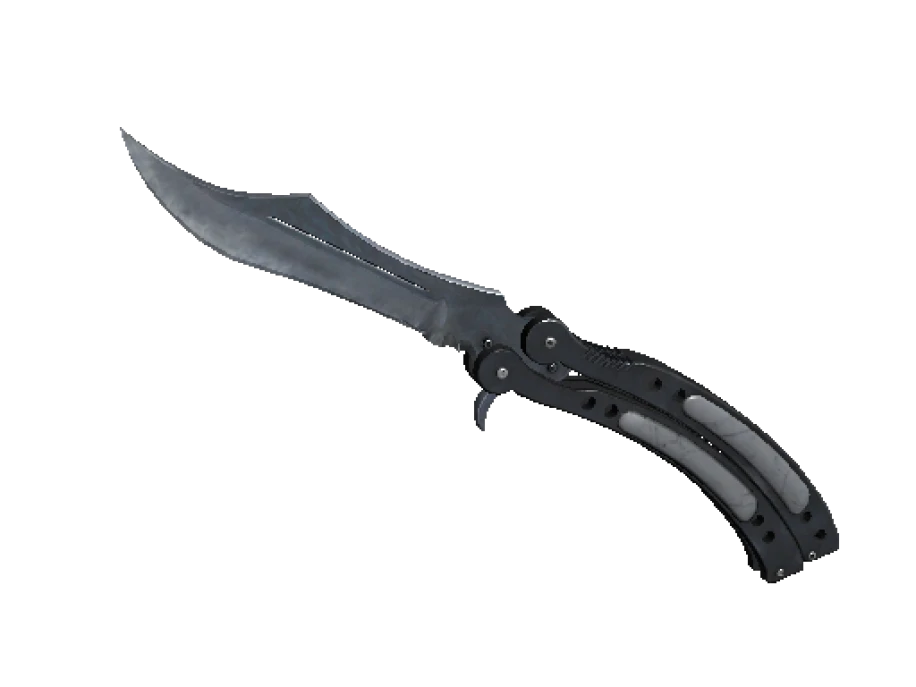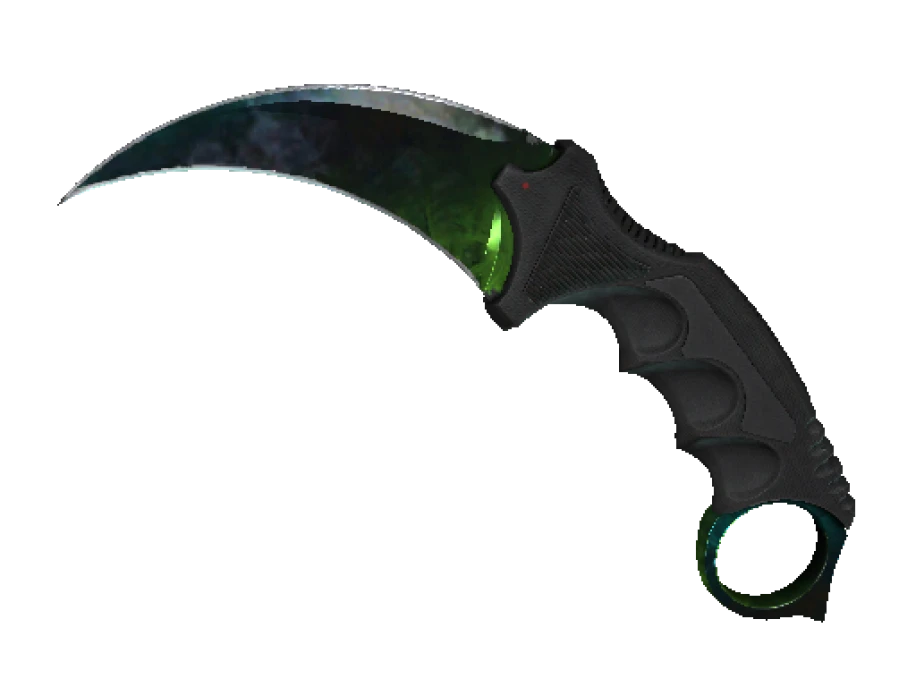



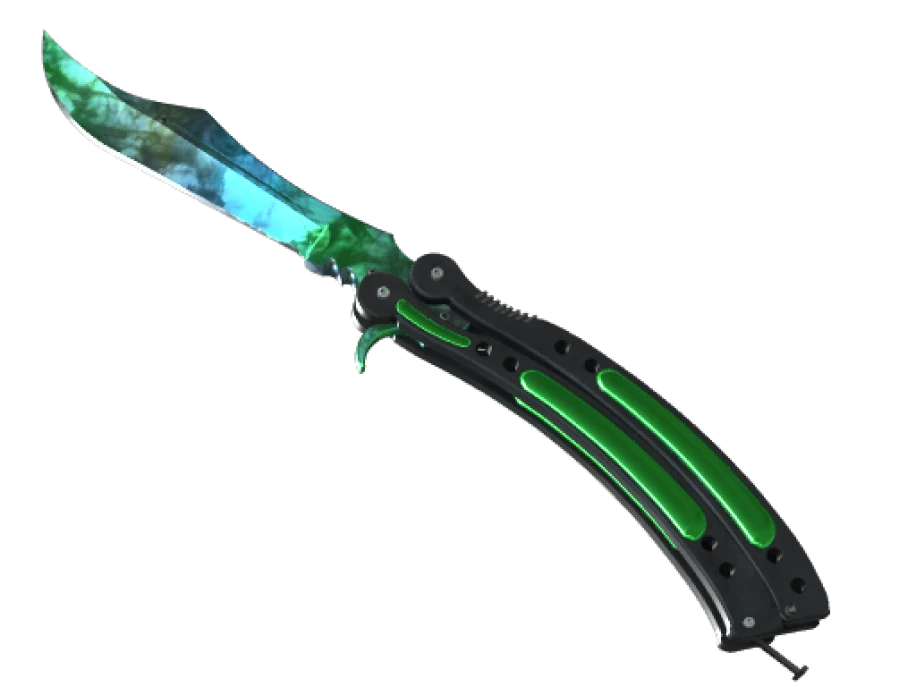
Gamma Doppler is the green cousin of Doppler. It arrived with the Gamma cases, it uses the same marble idea and the same short float range, and it swaps the pink and blue palette for greens. If you already know how Doppler works, most of that carries over. The parts that do not are what this guide is about.
The family
Gamma Doppler comes in five variants. Four numbered phases and one gem.
| Phase | Colors | Quick tell |
|---|---|---|
| Phase 1 | Dark green and blue-green in fairly even amounts | Balanced, with visible dark marbling. |
| Phase 2 | Mostly bright green | The green dominates. Top numbered phase. |
| Phase 3 | Dark green shading toward black | Light green highlights on a dark blade. |
| Phase 4 | Blue-green and teal | Less of the bright green, more of the cold tone. |
| Emerald | Solid bright green with black marbling | One clean color from every angle. The gem. |
Like Doppler, each variant is its own paint kit with its own paint index. The game rolls the phase when the knife is created and the pattern index then decides where the marbling lands within that phase. The phase is fixed. The pattern is fixed. Neither ever changes.
How it differs from Doppler
- One gem, not three. Doppler has Ruby, Sapphire and Black Pearl. Gamma Doppler has Emerald and nothing else above the numbered phases.
- Different cases. Doppler came from the Chroma cases. Gamma Doppler came from the Gamma cases.
- Different reading. On Doppler the question is how much pink versus blue. On Gamma Doppler the question is how bright the green is and how much of the blade goes dark or teal.
- Same float range. Both cap at 0.08, so Factory New and Minimal Wear are the only exteriors.
- It exists on a pistol. Glock-18 | Gamma Doppler carries the same five variants, Emerald included, on the slide.
The Emerald premium
Emerald is to Gamma Doppler what Sapphire is to Doppler. It is the rare roll, it is one clean color, and it is the version people picture when they say the finish name. It prices far above the numbered phases on every knife, and the gap is wider than the gap between Phase 2 and Phase 1.
Part of the premium is rarity. Part is that an Emerald has no bad seeds. A Phase 2 with a dark patch on the playside is a worse Phase 2. An Emerald is green from every angle, so buyers do not have to pick through them.
Below Emerald, Phase 2 leads because it is the brightest green. Phase 4 and Phase 1 sit in the middle and their order depends on the knife and on the pattern. Phase 3 is usually last, since it reads as a dark knife with green highlights rather than a green knife.
Where the pattern index matters
Within a numbered phase, the pattern index sets which part of the marbling faces you. A Phase 2 with bright green across the whole playside and only a little black is a better copy than a Phase 2 with a black or teal patch in the middle of the blade. Sellers price good playsides above average ones, and on a Karambit or a Butterfly Knife, where the blade fills your view, the difference is easy to see in a match.
On an Emerald the pattern index moves the black veins around and not much else. It rarely changes the price.
What to check on a listing
- Get the inspect link and run it through a float checker. The checker reads the paint index and names the phase. Emerald in a title is not evidence. The paint index is.
- Open the render and look at the playside. Confirm the phase matches. Then judge the pattern: how much of the visible blade is the phase’s main color, and how much is dark.
- Read the float. Everything is under 0.08, but a 0.079 is Minimal Wear with edge scratches and a 0.01 is not.
- Check the knife model against the price. An Emerald on a Gut Knife and an Emerald on a Karambit are the same phase and nowhere near the same money.
- Check for StatTrak in the name and make sure the price accounts for it one way or the other.
Green in the thumbnail tells you it is a Gamma Doppler. Only the paint index tells you which one.
Mistakes to avoid
- Buying a bright Phase 2 as an Emerald. A Phase 2 has visible marbling in more than one shade. An Emerald is a single green with black veins and nothing else.
- Buying a Phase 4 as a Phase 2 because the screenshot caught a green patch. Look at the whole playside, not the best spot on it.
- Comparing a Gamma Doppler price to a Doppler price. They are different finishes from different cases with their own markets.
- Ignoring a Minimal Wear label because the range is so short. The scratches are real and they show on a mirror finish.
On PrefireSkins every lot shows its exterior and, where known, its float from inspect data, so the float half of the check is done for you. The phase is yours to confirm, and it takes one paste into a checker.